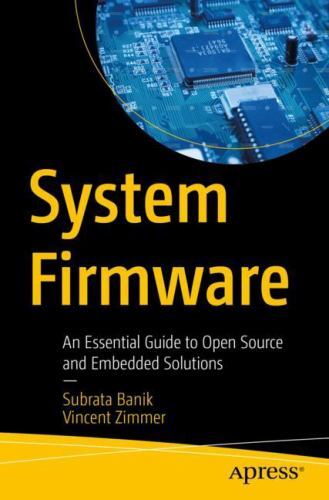
System Firmware Guide to Open Source and Embedded Solutions by Banik and Zimmer 2022 Trade Paperback

$ 26.17

Number of Volumes: 1 vol. Publication Name: System Firmware : an Essential Guide to Open Source and Embedded Solutions Dewey Decimal: 004 Dewey Edition: 23 Number of Pages: Xxx, 628 Pages Item Weight: 35.2 Oz Format: Trade Paperback LC Classification Number: QA76.758 gtin13: 9781484279380 Publication Year: 2022 Item Length: 9.3 in Illustrated: Yes ISBN-10: 1484279387 Subject Area: Computers Item Width: 6.1 in Author: Subrata Banik, Vincent Zimmer ISBN-13: 9781484279380 Language: English brand: Apress L. P. Type: Textbook Subject: Software Development & Engineering / General, Hardware / General, Programming / Open Source, Security / General Publisher: Apress L. P. Synopsis: Find the right bootloader solution or combination of firmware required to boot a platform considering its security, product features, and optimized boot solutions. This book covers system boot firmware, focusing on real-world firmware migration from closed source to open source adaptation. The book provides an architectural overview of popular boot firmware. This includes both closed sourced and/or open source in nature, such as Unified Extensible Firmware Interface (UEFI), coreboot, and Slim Bootloader and their applicable market segments based on product development and deployment requirements. Traditional system firmware is often complex and closed sourced whereas modern firmware is still a kind of hybrid between closed and open source. But what might a future firmware model look like? The most simplistic boot firmware solution uses open source firmware development. This book helps you decide how to choose the right boot firmware for your products and develop your own boot firmware using open source. Coverage includes: Why open source firmware is used over closed source The pros and cons of closed and open source firmware A hybrid work model: for faster bring-up activity using closed source, binary integrated with open source firmware What You Will Learn Understand the architecture of standard and popular boot firmware Pick the correct bootloader for your required target hardware Design a hybrid workflow model for the latest chipset platform Understand popular payload architectures and offerings for embedded systems Select the right payload for your bootloader solution to boot to the operating system Optimize the system firmware boot time based on your target hardware requirement Know the product development cycle using open source firmware development Who This Book Is For Embedded firmware and software engineers migrating the product development from closed source firmware to open source firmware for product adaptation needs as well as engineers working for open source firmware development. A secondary audience includes engineers working on various bootloaders such as open source firmware, UEFI, and Slim Bootloader development, as well as undergraduate and graduate students working on developing firmware skill sets., Find the right bootloader solution or combination of firmware required to boot a platform considering its security, product features, and optimized boot solutions. This book covers system boot firmware, focusing on real-world firmware migration from closed source to open source adaptation. The book provides an architectural overview of popular boot firmware. This includes both closed sourced and/or open source in nature, such as Unified Extensible Firmware Interface (UEFI), coreboot, and Slim Bootloader and their applicable market segments based on product development and deployment requirements. Traditional system firmware is often complex and closed sourced whereas modern firmware is still a kind of hybrid between closed and open source. But what might a future firmware model look like? The most simplistic boot firmware solution uses open source firmware development. This book helps you decide how to choose the right boot firmware for your products and developyour own boot firmware using open source. Coverage includes: Why open source firmware is used over closed source The pros and cons of closed and open source firmware A hybrid work model: for faster bring-up activity using closed source, binary integrated with open source firmware What You Will Learn Understand the architecture of standard and popular boot firmware Pick the correct bootloader for your required target hardware Design a hybrid workflow model for the latest chipset platform Understand popular payload architectures and offerings for embedded systems Select the right payload for your bootloader solution to boot to the operating system Optimize the system firmware boot time based on your target hardware requirement Know the product development cycle using open source firmware development Who This Book Is For Embedded firmware and software engineers migrating the product development from closed source firmware to open source firmware for product adaptation needs as well as engineers working for open source firmware development. A secondary audience includes engineers working on various bootloaders such as open source firmware, UEFI, and Slim Bootloader development, as well as undergraduate and graduate students working on developing firmware skill sets. Table Of Content: Chapter 1: Introduction.- Chapter 2: Knowing Your Hardware.- Chapter 3: Understanding BIOS and Minimalistic Design.- Chapter 4: System Firmware Architecture.- Chapter 5: Hybrid Firmware Architecture.- Chapter 6: Payload.- Chapter 7: Case Studies.- Appendix A: Postcodes.- Appendix B: Data Types.

Description

  1. This book is a must-have for anyone diving into system firmware! Packed with clear explanations and practical insights on open-source and embedded solutions, it’s perfect for both beginners and experts. The authors break down complex topics in an easy-to-follow way, making it super useful for real-world applications. Highly recommend for firmware developers and tech enthusiasts!

    deely6ba68e9